
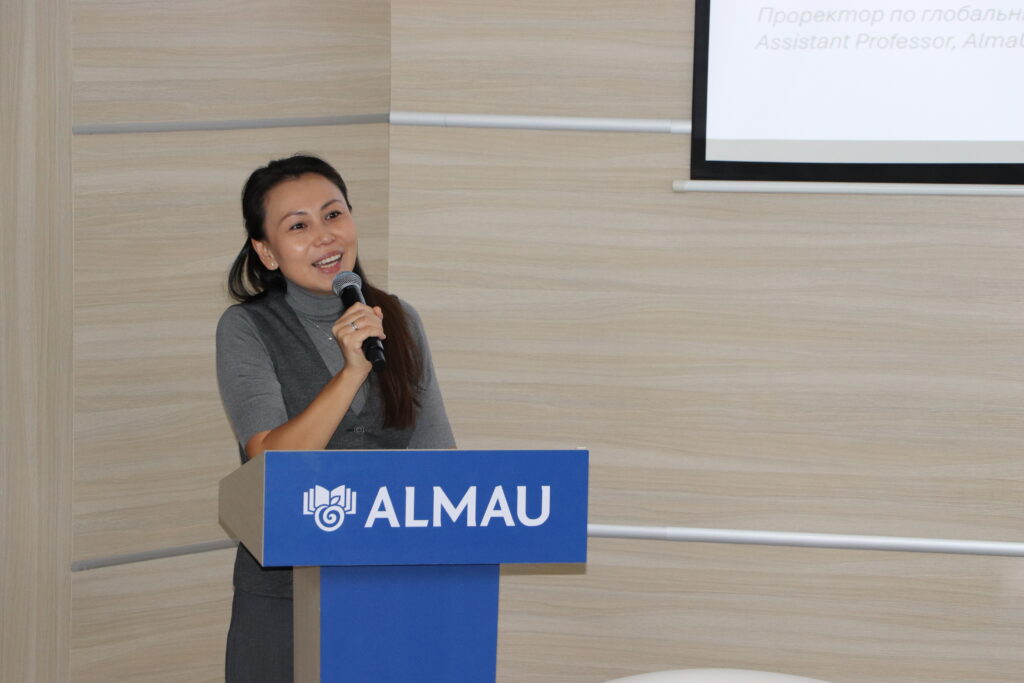
Almaty Management University hosted the event “She in Science: Start and Development in Science,” dedicated to the International Day of Women and Girls in Science. The event aimed to reflect on women’s contributions to the development and formation of a sustainable scientific community, where leadership, professional resilience, and intellectual potential are considered key factors of scientific progress.
The opening remarks were delivered by AlmaU’s First Vice-Rector Timur Buldbaev:
“There are no boundaries in science. The International Day of Women and Girls in Science highlights the immense contribution to science, technology, and innovation, and serves as a reminder of the need to create equal opportunities for all those aspiring to engage in research, support equal access for women and girls in STEM, inspire the next generation of women researchers, overcome existing gender barriers in academic and scientific environments, and recognize the achievements of women who advance science through their work.”
The first presentation highlighted the changes needed to encourage girls’ participation in STEM. Meirgul Alpysbayeva, National Education Specialist at UNESCO, shared her perspective:
“At UNESCO, gender equality is a global priority, and in education we implement and promote gender equality. It all starts from early childhood – in preschools, at school desks, where values and visions are formed. Women still make up only 35% of STEM graduates. In Kazakhstan, the situation is slightly better, but we need to examine where women and girls are represented. Girls often face biases, social norms, and expectations. This is all shaped by the environment we live and study in, and today, technological development has a strong influence. On one hand, technology creates opportunities and conditions, but on the other, it increases risks. Research shows that women and girls are most affected by harassment and bullying in online spaces.”
As part of the event, AlmaU’s Vice-Rector for Global Partnership, Sholpan Tazabek, delivered a keynote lecture titled “Science Without Glamour: The Real Path of a Woman Researcher”, which explored practical aspects of an academic career:
“Many women in academia have to balance multiple roles. At the start of a scientific career, we see full equality – 50% women; in the professorial ranks, only 20-25%; in STEM, even less – under 15%. Women do not disappear at the beginning; the system loses them later. This means the issue is not talent, ambition, or lack of effort. Academia has an unspoken image of a ‘true scientist’: always available, ready to work 50-60 hours per week, geographically mobile, and fully focused on work. Research shows this is not a neutral image – it is historically and culturally shaped, and importantly, male-oriented.”
The Synaptic Leadership session was presented by Moldir Poshtar, PhD in Education. She introduced a model of contemporary women’s leadership based on research results and practical experience, emphasizing the importance of a human-centered and connected approach to management and scientific work:
“Women’s leadership is not an exception, but a real resource for science. I strongly believe in the power of professional communities, conferences, and women’s associations where support, solidarity, and open dialogue exist. These are warm, safe, and living spaces. Spaces where you can be yourself rather than ‘fit a mold,’ and where your voice is heard. Each of you can become a synaptic leader: develop yourself, inspire others, influence your environmen. Build connections that change the world for the better.”
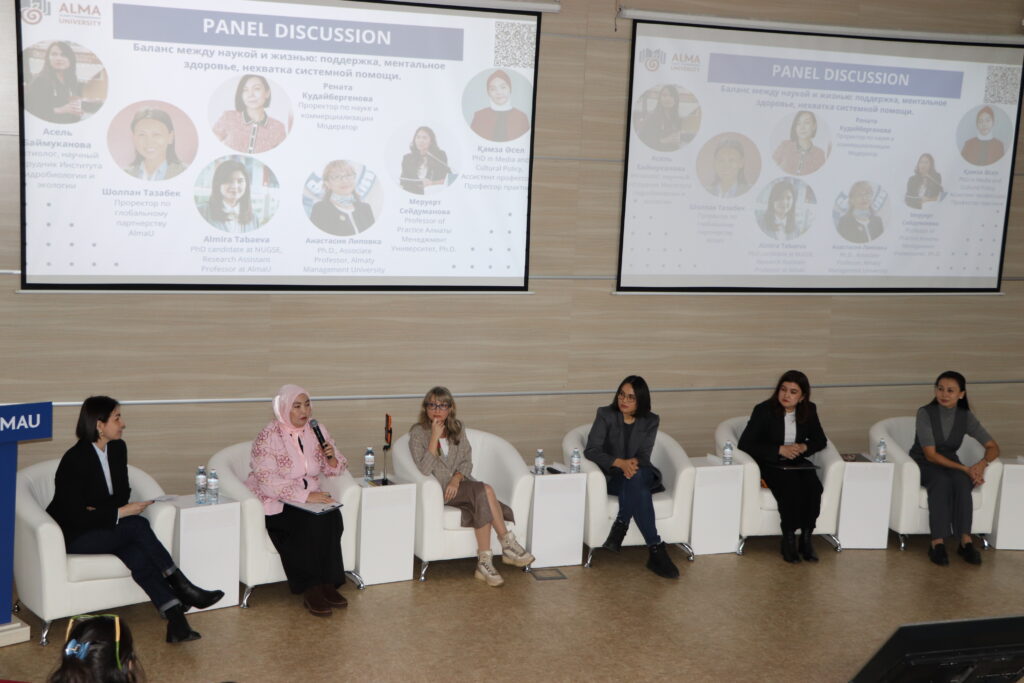
The program continued with a panel discussion titled “Balancing Science and Life: Support, Mental Health, and Lack of Systemic Assistance.” Participants included scientists Anastasia Lipovka, Almira Tabaeva, Meruert Seydumanova, Asel Baymukanova, Kamza Asel, and Meirgul Alpysbayeva. The discussion was moderated by AlmaU Vice-Rector for Science and Commercialization, Renata Kudaybergenova. The panel explored issues of balancing scientific work and personal life, mental well-being, and the role of research teams and institutional environments in shaping a sustainable academic trajectory.
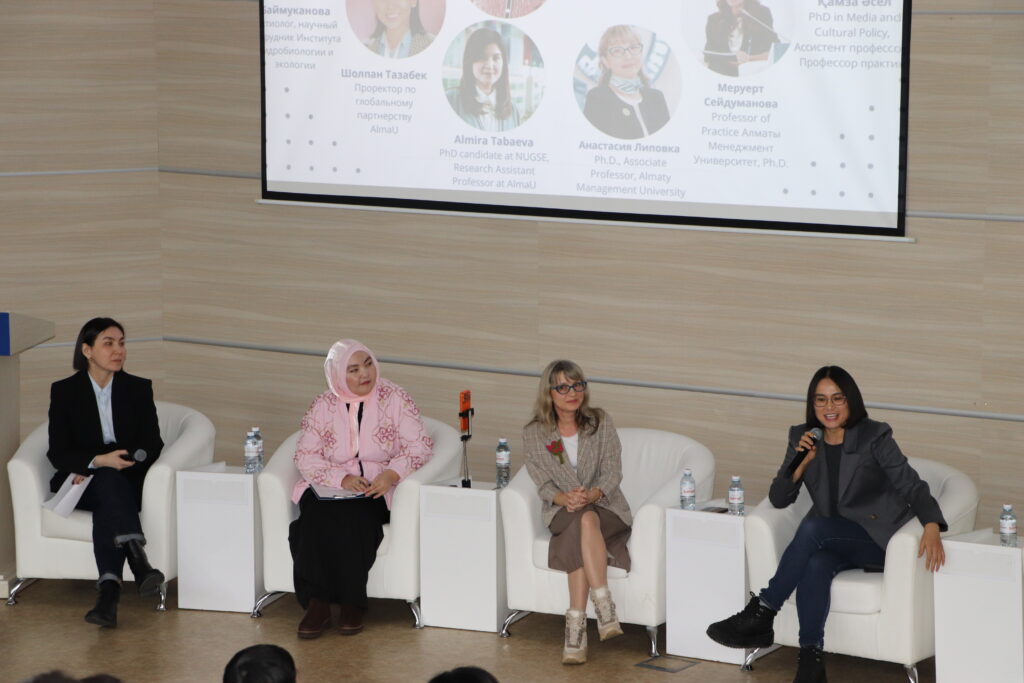
Kamza Asel, PhD in Media and Cultural Policy, Assistant Professor, Professor of Practice:
“At the beginning, it was difficult. I studied in a doctoral program abroad, spending 3.5 years there alone with my child. At first, I regretted taking such a step, but I promised myself I would get to the end and overcome all the difficulties I faced. Now, I have no regrets – all those long days and nights are behind me.”
Anastasia Lipovka, PhD, Associate Professor, AlmaU:
“I have been researching gender in economics and society for over 17 years, specifically studying what prevents women from advancing in business careers. My scientific path has been very long – I defended my master’s thesis on gender back in 2008. My research covers all Central Asian countries as well as Central and Eastern Europe. Through comparative analysis, I identify positive and negative opportunities. The problem of women in science is linked to obligations. We are not talking about equality of rights – that exists – we are talking about equality of opportunities. We are not discussing visible problems; we focus on issues people face at the family level, psychologically, and regarding invisible barriers in career development.”
Asel Baymukanova, zoologist, Researcher at the Institute of Hydrobiology and Ecology:
“I am a field scientist, studying Caspian seals, going on long expeditions. The question of whether to go or not never arose for me, despite being a 20-year-old woman. The hardest part for me was convincing others that a girl, a young woman, could work in the field on par with men. Men are usually preferred in the field conditions in which I spend weeks twice a year. I am the only woman taken to the most challenging conditions, entrusted with carrying heavy equipment – and I want and can do it. I had to learn a lot to be part of a field expedition. I run, catch seals, hold them, crawl, film, conduct scientific work and statistics, write papers, get up at six, and go to bed last – so that there would be no reason not to take me. I did everything possible to stay. Six months ago, I broke my arm and missed a season – it was the hardest time for me in my ten years in science. But soon, in spring, I will go again, working with the core seal monitoring team, exploring the Caspian again, and studying its issues. Women are often not taken to fieldwork because of concerns about reproductive health. But I made a choice: I want to be a field scientist, a zoologist; I want to be a woman who can carry a boat and work on equal terms with men. Ten years ago, no one would have believed it.”
Almira Tabaeva, PhD Candidate at NUGSE, Research Assistant Professor at AlmaU:
“I study gender issues in education. I was born in Karakalpakstan, near the Aral Sea, in a small ordinary town. Among 30 graduates in my class, I was the only girl to receive higher education. My classmates, neighbors, friends – some very talented – could not go to Tashkent due to sociocultural and economic barriers. I always wondered where such inequality comes from. It felt unfair. Later, I went to India to study feminism, interested in Global South feminist theories, but they did not reflect our women’s experiences. Only ten years later did I enter a doctoral program, moving from Uzbekistan to Kazakhstan, and became the wife of the only long-awaited son of a traditional Kazakh family. I received grants from the UK but could not go due to circumstances. I began documenting our theories.”
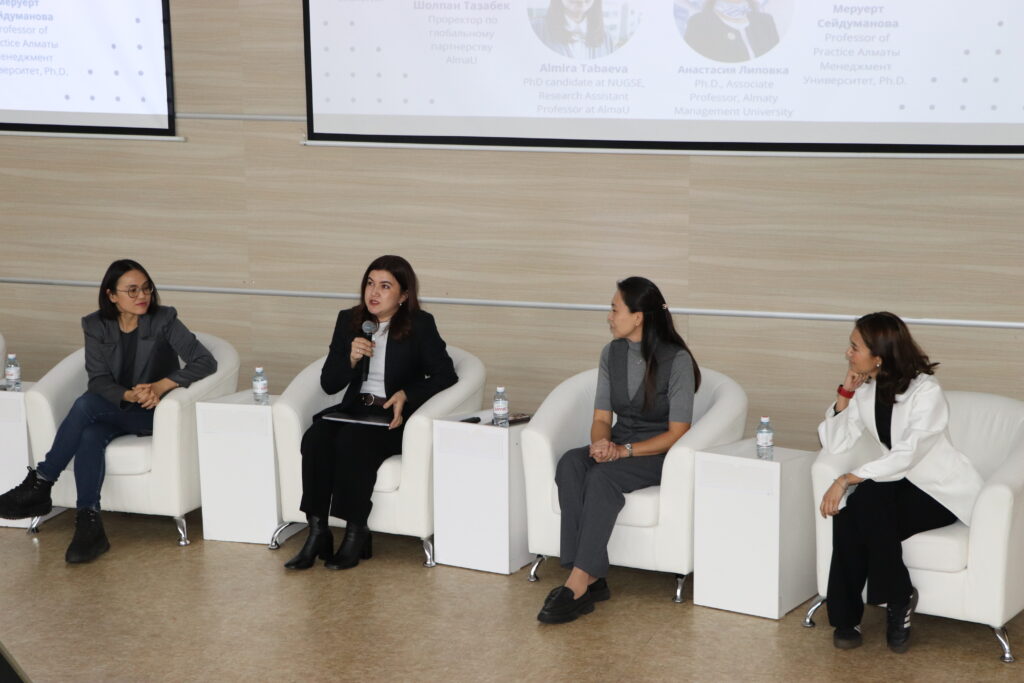
Sholpan Tazabek, Vice-Rector for Global Partnership, AlmaU:
“My path in science began with a PhD. A wonderful but challenging life began. I started my PhD unmarried. Now I am simultaneously a fellow of various funds. Somehow, it always happened that I submitted reports on the day of giving birth. There were moments when a major German fund requested a report, and I couldn’t submit it – they accommodated, extended the deadline. Our remarkable trait is that we do not see this as a problem; it is the reality in which we grew up and continue to develop. One always hopes the system supports this.”
Meruert Seydumanova, PhD, Professor of Practice, AlmaU:
“I began my path already in my bachelor’s studies. Then I worked at the Kazakhstan Institute of Strategic Development, conducting economic research for about two years. Later, I trained at Nazarbayev University, continued research, and then studied in Hong Kong. During my master’s, I had my first child. Our professors then said: ‘Kazakh women – you can do everything.’ That is what distinguishes us: we can fulfill all our roles and have family support. During my doctoral studies, I had my second child. There was COVID and a difficult period. I want to say: no matter the chaos, you must continue to focus. Chaos will always exist. There will never be a perfect time, six free hours to write a dissertation – you just have to do it.”
A special part of the program was the open microphone format, where participants shared personal stories of their scientific paths, experiences writing papers during maternity leave, practices of mutual support, and overcoming professional challenges. The event concluded with a reflective art-based activity facilitated by Almira Tabaeva and an informal brunch, fostering continued dialogue and strengthening professional connections.
The event “She in Science: Start and Development in Science” highlighted the importance of a non-idealized view of a scientific career and confirmed women’s contributions to the development of science, research, and academic leadership.