
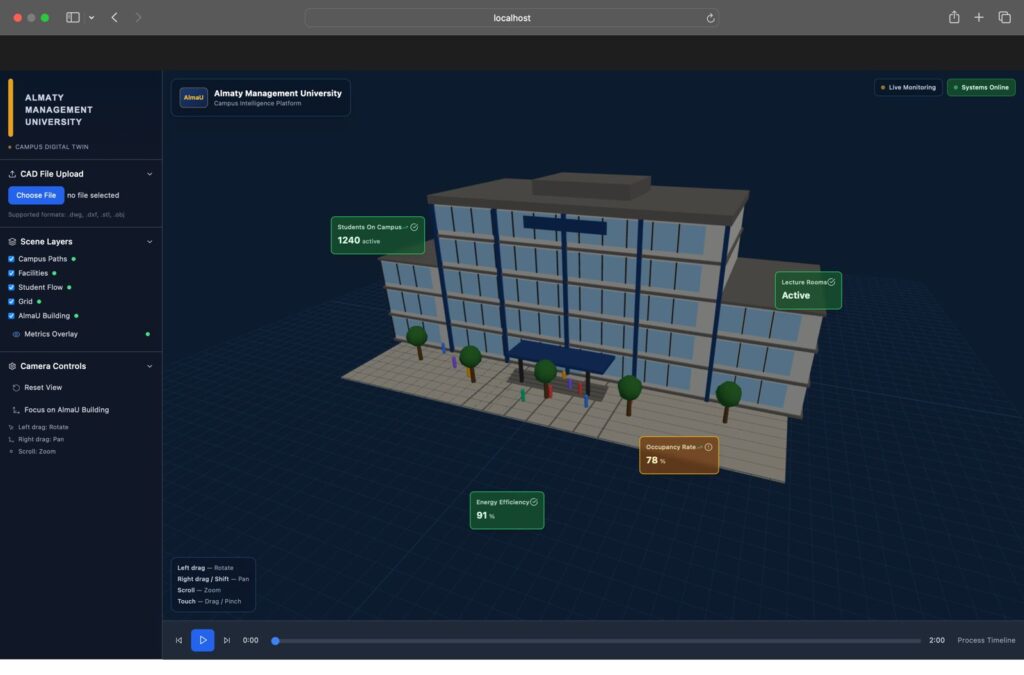
At Almaty Management University, within the School of Digital Technologies and Economics, a digital twin of the university is currently being developed. This solution represents a comprehensive digital environmental dynamic model encompassing all key institutional processes.
Unlike traditional information systems, it is not merely a static data repository, but a unified digital space integrating information on buildings and classrooms, schedules and teaching workloads, user movements across campus, academic performance, financial indicators, and KPIs. As a result, a holistic view of the university’s day-to-day operations is formed.
The project is based on adapting digital twin technology widely used in industry to the higher education sector. This approach remains largely unexplored in universities, making it both innovative and pioneering. Combined with artificial intelligence, visual analytics, and simulation tools, the solution serves not only as a research platform but also as a practical instrument with strong potential for scaling across other educational institutions.
Why It Matters
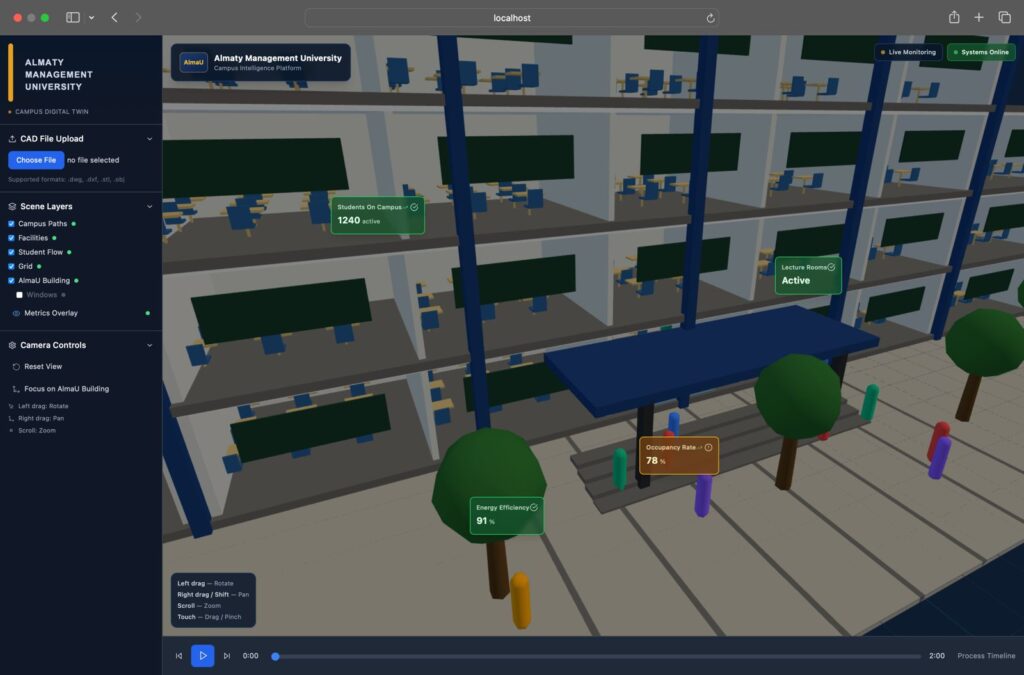
The key distinction between this platform and widely used systems such as Learning Management Systems (LMS) and Enterprise Resource Planning (ERP) lies in its focus on analytics and simulation. A digital twin does not simply store data; it enables real-time interaction with a 3D model of the university, including «what-if» scenario building and the testing of managerial decisions prior to implementation.
This approach supports a shift from intuition-based management to data-driven decision-making grounded in objective analytics.
The need for such a solution stem from a systemic challenge common to educational institutions: fragmented data and limited processing speed. Despite the presence of multiple digital systems, information is often distributed across various sources, arrives with delays, and fails to provide a unified analytical picture. Consequently, management decisions are frequently based on incomplete or subjective data.
Practical Applications
The digital twin under development is designed to address a range of applied challenges. In resource management, the system helps identify inefficient use of classroom space, optimize scheduling, and balance teaching workloads across faculty. This leads to a more sustainable allocation of resources and directly enhances the quality of education.
In terms of academic quality, the platform enables early detection of academic risks, allowing for timely identification of underperforming students and the development of personalized learning pathways. Additionally, data on user movement across campus provides insights into actual space utilization, helping identify areas of congestion or underuse. At a strategic level, the system supports enrollment modeling, evaluation of new academic program opportunities, and forecasting of key performance indicators. Overall, the implementation of a digital twin is expected to increase infrastructure utilization by 15-30%, reduce operational costs, and facilitate a transition toward more evidence-based, data-driven management.
System Architecture
The technical architecture of the digital twin consists of several interconnected layers. At the data level, the system integrates with existing platforms such as LMS, ERP, and access control systems (ACS), along with IoT sensors and additional data sources.
The backend is built on the .NET framework. A graph database, Neo4j, is used to store and analyze relationships between students, courses, faculty, and facilities, reflecting the highly interconnected nature of the university environment.
The analytics layer incorporates predictive analytics, behavioral analysis, and optimization algorithms. The user interface is developed using React.js, while campus visualization is implemented through WebGL and Three.js, supported by mapping tools and analytical dashboards.
Current Stage of Implementation
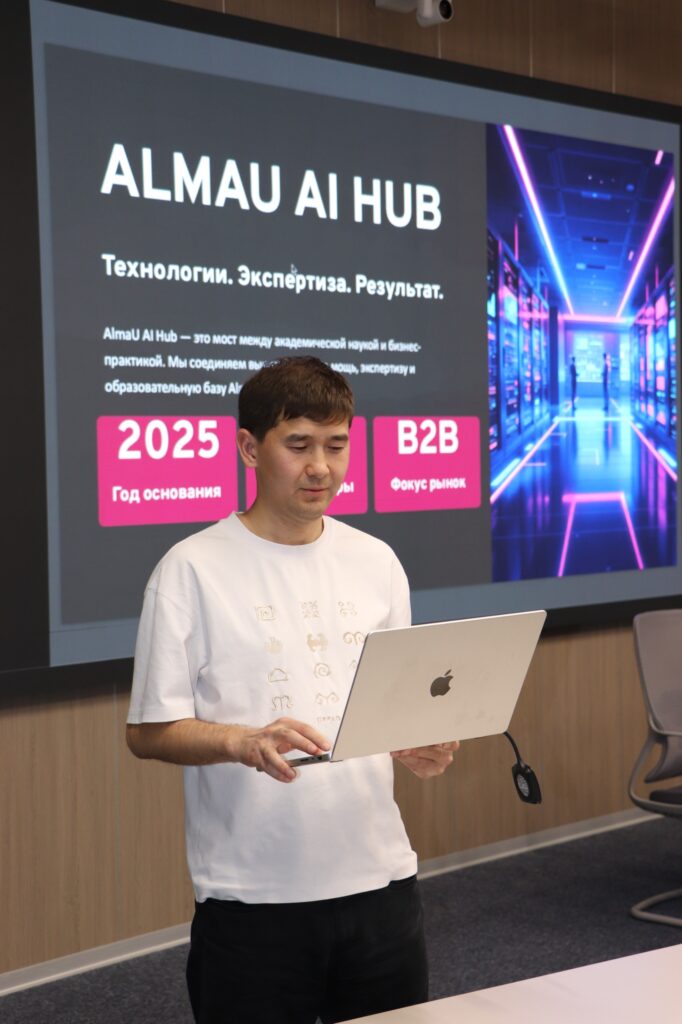
In early December 2025, the AlmaU AI Hub was launched at the university. According to the Director of AlmaU AI Hub, Daulet Sabyr:
«The concept has been formed, the architecture designed, the core data model is ready, and a UX concept has been developed. Initial pilot scenarios are already in place, with visualization and analytics operating in test mode».
This indicates that the project is ready for further scaling and integration into the university’s management processes.
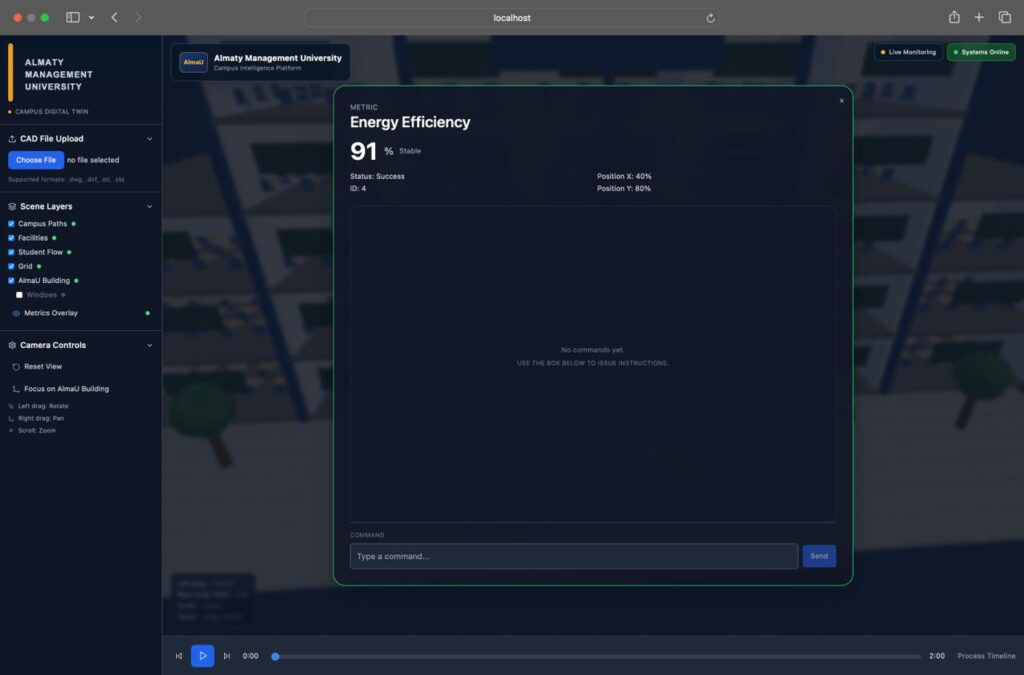
The system’s functionality is tailored to different user groups. Students gain access to an interactive campus map, real-time classroom availability, and personalized academic analytics, including course recommendations and early warnings about potential academic risks. Faculty members can analyze their workloads, compare outcomes across different cohorts, and receive recommendations for improving the educational process. At the administrative level, decision-makers use a unified dashboard that provides a real-time overview of the system and tools for forecasting and scenario modeling.
The interface combines two approaches: a conversational format that allows users to submit queries in natural language, and visual analytics tools including charts, maps, and a 3D campus model.
Prospects
The scientific significance of the project lies in its interdisciplinary nature and practical orientation, as it is developed at the intersection of education, data analytics, and digital technologies.
Research conducted within the project includes learning analytics, focusing on student behavior analysis and the development of predictive models, enabling actionable insights based on real-world data.
In the long term, the digital twin may serve as a platform for fostering entrepreneurial and research activities within the university.
«In the future, the twin could become a platform where students launch startups, researchers conduct experiments, and the solution itself is commercialized for the education market» – notes Daulet Sabyr.
Thus, the project extends beyond an internal management tool, forming the foundation for a new digital ecosystem in education.