
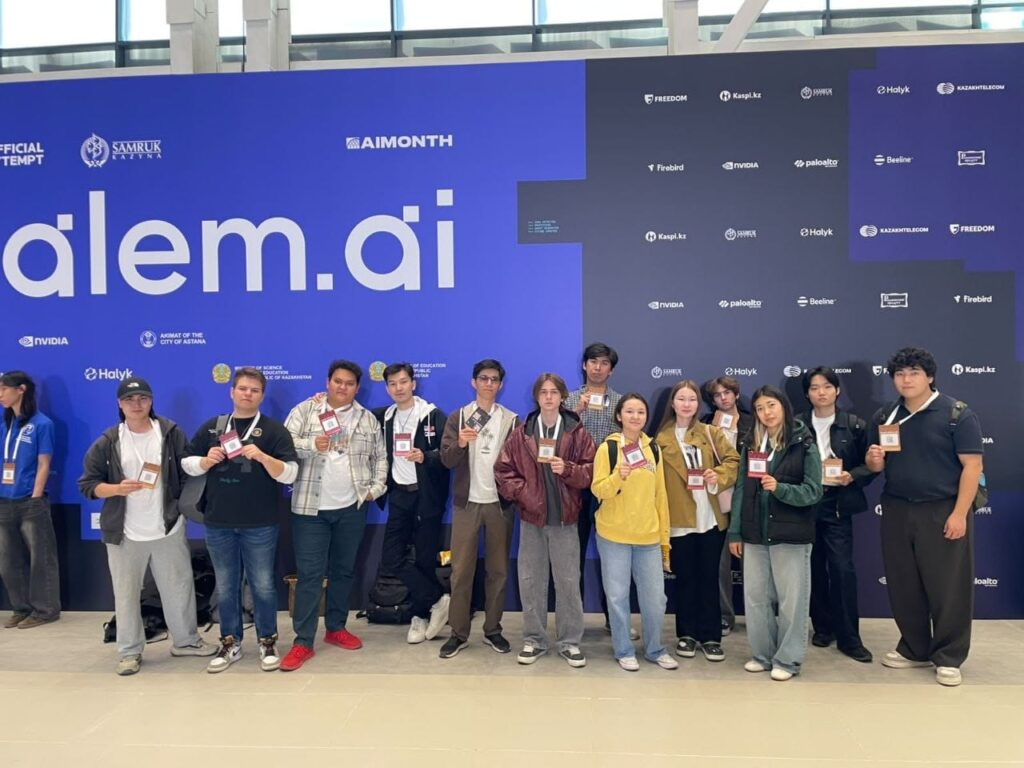
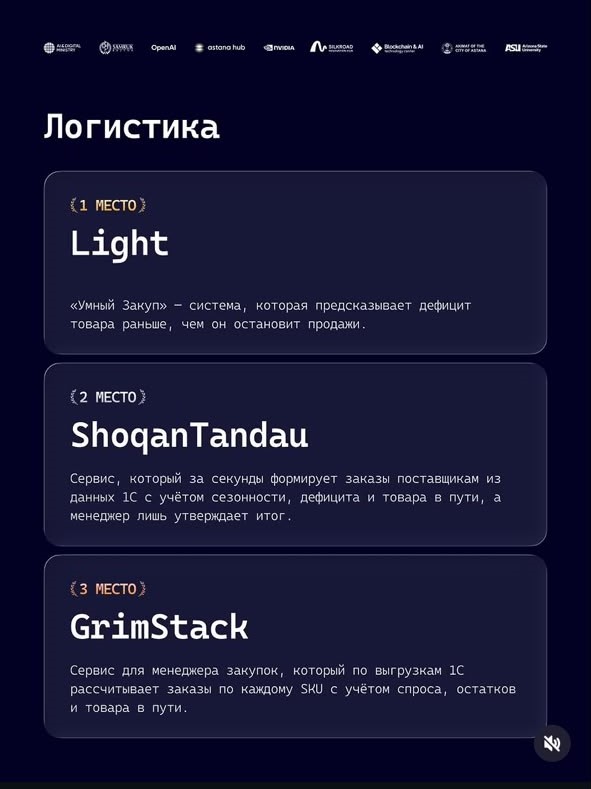
The GrimStack team secured third place in the Logistics track at the international HackAlem AI hackathon. The service developed by the students helps distributors forecast product demand more accurately and automate the preparation of supplier orders. Based on test data covering March-August 2026, the forecast for Systeme Electric products was 16.6% more accurate than the Excel-based calculation method.
On September 23, 2026, the international HackAlem AI hackathon brought together more than 2,400 participants. Over 800 teams took part in the competition, developing artificial intelligence solutions to address practical challenges in business and the public sector.
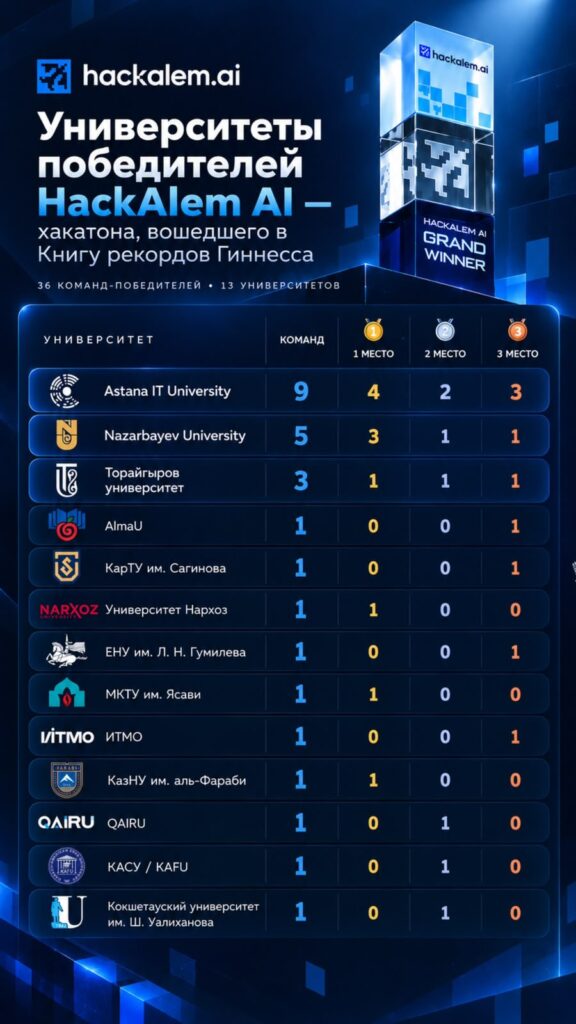
AlmaU was represented by students from the Information Systems, Data Science, Software Engineering, and Product Management academic programs. The finalists were announced on October 14, project presentations before the jury took place on October 16, and the organizers announced the final results on October 18. The GrimStack team placed third in the Logistics track. According to the results provided by the organizers, AlmaU also ranked fourth in the overall team standings.
The GrimStack project addresses a challenge familiar to many distributors: how to determine the quantity of goods to order from suppliers without risking stock shortages or tying up capital in excess inventory. Traditionally, procurement managers estimate demand in Excel based on average sales over the previous 12 months. However, this approach does not always reflect actual market conditions. GrimStack offers an alternative approach. The service processes historical sales data, generates forecasts for individual product items, and calculates recommended order quantities while accounting for current warehouse stock, goods in transit, and packaging multiples.
The GrimStack prototype was developed using a business case provided by Elektrokomplekt, involving the IEK and Systeme Electric suppliers. Testing conducted using data from March to August 2026 showed that the forecast for Systeme Electric products was 16.6% more accurate than the Excel-based method, delivering better results across all six evaluation points. This performance became one of the key indicators of the project’s practical value for business.
The developers emphasize that the project is still under development. The current working version runs locally, and a publicly accessible online service has not yet been launched.
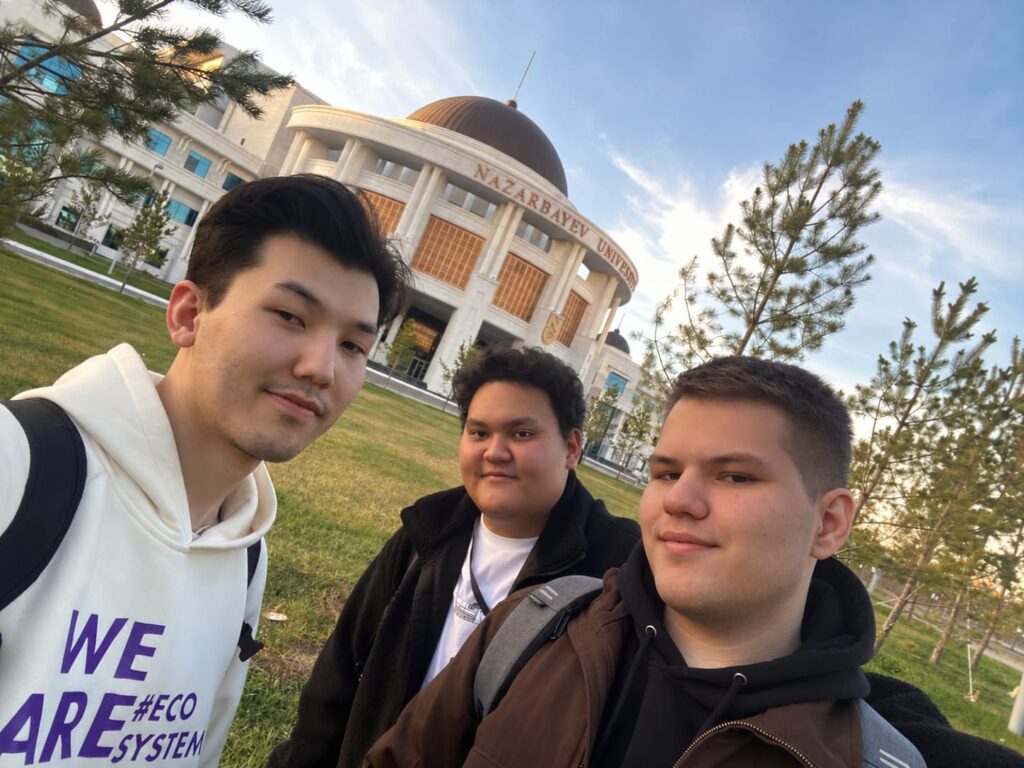
The GrimStack team consists of three third-year students from AlmaU’s School of Digital Technologies, enrolled in the Software Engineering program:
- Aliar Nurkanat, Tech Lead – responsible for data processing and the forecasting algorithm.
- Bekzat Ubniev, Backend Developer – responsible for API development and component integration.
- Stanislav Mamaev, Frontend Developer – responsible for the user interface and user experience (UX).
Developing the project required the team to integrate data processing, forecasting algorithms, backend logic, and the user interface into a single product. The participants had just five hours to build their solution during the hackathon.
“This is recognition of our work and an opportunity to introduce our project to a wider audience. Third place opens up opportunities to connect with industry representatives, experts, and potential partners. It confirms that our solution addresses a real business need and motivates us to continue developing GrimStack,” the team members said.
The next stage of GrimStack’s development will focus on reducing manual operations and expanding the service’s potential user base. The team plans to integrate directly with 1C, enabling scheduled calculations without manually uploading files, support additional data formats, and incorporate new suppliers.
“We plan to continue developing the project. Our immediate goal is to automate the process through direct integration with 1C, support other data export formats, and add new suppliers. We want to scale GrimStack and make it useful not only for one company but also for other distributors,” the developers explained.
For the team, participating in HackAlem AI was an opportunity to test their skills under strict time constraints.
“It was an intense and exciting experience. We worked at a fast pace for five hours, and the main challenge was to build a functioning product within the available time. Defending our project before the jury was the most nerve-racking moment, while hearing that we had secured third place brought us genuine joy. It confirmed that we are working on something valuable and gave us strong motivation to keep moving forward,” the GrimStack team members noted.
Other AlmaU students also participated in HackAlem AI, representing Data Science, Software Engineering, and other academic areas across the university. They included Dinmukhamed Bekeshev, Timur Medikhanov, Aidos Amangeldi, Aldiyar Amantai, Mikhail Erastov, Temirlan Tolegenov, Aruzhan Yerzhanova, Uldana Tolegenkyzy, Malika Turar, Ilya Kim, Yerassyl Zekebayev, Rodion Kekhaev, and Daulet Sabyr.
In a rapidly evolving world where artificial intelligence and digital technologies are transforming business, it is important not merely to follow these changes but to develop solutions that respond to emerging market needs.
AlmaU students’ participation in HackAlem AI demonstrates how university education can be connected with practical application. By working on real-world business cases, students develop technological solutions and test their potential in practice.