
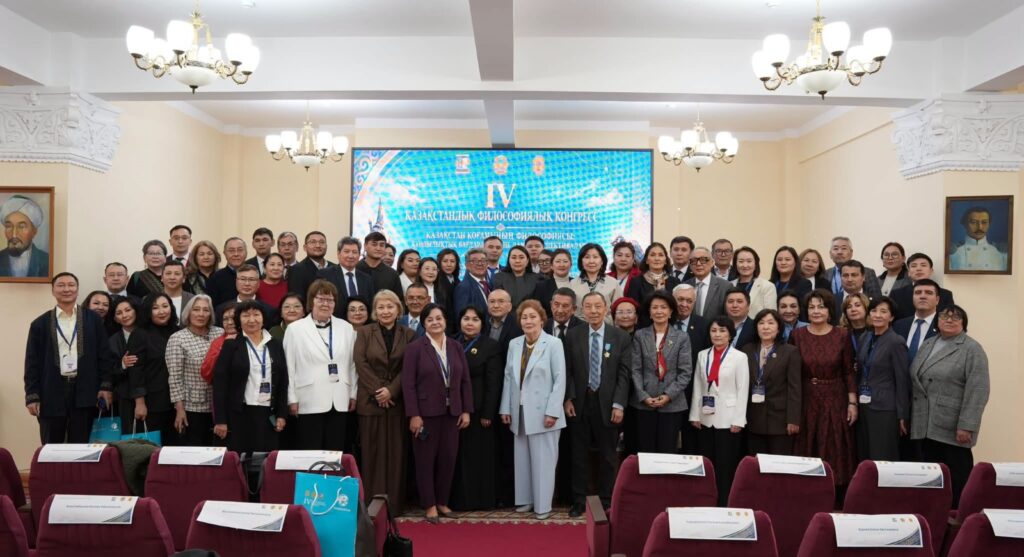
On November 7, 2026, Almaty hosted the discussion forum “Steppe Philosophy: Formation of a Research Field, Sources, Concepts and Methodology” as part of the IV Kazakhstan Philosophical Congress.
The event was organized by the “Uly Dala Akademiyasy” Research Center at AlmaU and the “Steppe Philosophy” initiative group.
The forum brought together Kazakhstani and international scholars, philosophers, historians, cultural studies researchers and academics from Kazakhstan and Kyrgyzstan to discuss the intellectual heritage of the Great Steppe, its philosophical foundations and the prospects for establishing an independent field of academic research.
The moderator was Nurzhan Kulумzhanov, Director of the “Uly Dala Akademiyasy” Research Center at AlmaU, PhD, Associate Professor and Head of the “Steppe Philosophy” initiative group.
Participants focused on the conceptual and methodological development of Steppe Philosophy, the reconstruction of the worldview foundations of nomadic civilization, and the interpretation of traditional values and their relevance in the context of globalization and digitalization.
The academic programme comprised three thematic areas.
The first area, “Ontological and Epistemological Foundations and Methodological Principles of Research into Steppe Philosophy,” addressed the definition of the subject field of this emerging research area, methodologies for studying the intellectual heritage of the Great Steppe, the philosophical legacy of Kazakh thinkers, oral intellectual traditions, and the spiritual and moral foundations of nomadic civilization.
The second area, “Transformation of the Value Orientations of Steppe Thought in Response to the Challenges of Globalization and Digitalization,” explored issues of national identity, cultural belonging, gender equality, migration and the transformation of social values. Particular attention was given to the philosophical interpretation of the concepts of “kisilik” and “zhurek” within the Kazakh intellectual tradition.
The third area, “Axiological Priorities and Socio-Ethical Dimensions of Nomadic Civilization,” focused on the national idea, the ethics of hospitality, people’s diplomacy, intercultural understanding, national identity and the development of a culture of responsible action.
The forum was attended by representatives of leading academic and educational institutions from Kazakhstan and Kyrgyzstan, including Ala-Too International University, J. Balasagyn Kyrgyz National University, the Institute for Philosophy, Political Science and Religious Studies of the Science Committee of the Ministry of Science and Higher Education of the Republic of Kazakhstan, Al-Farabi Kazakh National University, Kazakhstan-German University, AlmaU and other organizations.
A special place in the programme was given to the discussion forum “Philosophical Synedrion: Steppe Philosophy in the Discourse of the 21st Century.” During the meeting, the initiative group presented its concept of Steppe Philosophy, followed by an expert discussion involving leading Kazakhstani scholars and representatives of the philosophical community.
The invited experts included Murat Sabitov, Doctor of Philosophical Sciences, Professor; Sergey Kolchigin, Doctor of Philosophical Sciences, Professor; Natalia Seidakhmetova, Corresponding Member of the National Academy of Sciences of the Republic of Kazakhstan; Professor Zukhra Ismagambetova; Professor Almira Nauryzbayeva; Aslan Zhaksylykov, Doctor of Philological Sciences, Professor; and other distinguished members of the academic community.
Particular attention was devoted to the “Steppe Philosophy” research programme, which aims to develop the conceptual, terminological and methodological foundations of Steppe Philosophy as an independent interdisciplinary field dedicated to studying the intellectual heritage of the Great Steppe and its place in the history of world philosophy.
The programme предусматривает the systematization of key categories of the Steppe worldview, including “Tengri,” “kut,” “zhol,” “el,” “kisilik,” “ar,” “namys,” “uyat,” “adilet,” “amanat” and others; the development of comparative philosophical research; and the preparation of fundamental monographs, an academic terminological dictionary, scholarly publications and educational courses.
An important area of work identified was the integration of Steppe Philosophy research with the philosophical anthropology of the holistic human being and the Tolyq Adam concept developed at AlmaU. In this context, the moral foundations of responsible action, conscious leadership and entrepreneurship are of particular relevance.
Participants also discussed prospects for promoting this research agenda internationally. In particular, an initiative was presented to prepare a proposal for organizing a “Steppe Philosophy” discussion forum as part of the XXVI World Congress of Philosophy, scheduled to take place in Tokyo in 2028. Implementing this initiative would provide an opportunity to present the results of Kazakhstani research to the international philosophical community and expand the scope of intercultural and comparative philosophical dialogue.
The event concluded with a review of its academic and practical outcomes and the identification of further areas of work. These include developing the methodology for researching Steppe Philosophy, establishing its conceptual framework, strengthening interdisciplinary and international academic cooperation, preparing collaborative scholarly publications and integrating research findings into educational practice.
The discussion forum marked an important step towards consolidating the research community around the study of the intellectual heritage of the Great Steppe and the development of a new academic field aimed at revealing its philosophical potential in the context of contemporary global thought.
Participants and Topics of Academic Presentations
As part of the academic programme, scholars and experts from Kazakhstan and Kyrgyzstan presented their research.
The first thematic area, “Ontological and Epistemological Foundations and Methodological Principles of Research into Steppe Philosophy,” featured the following presentations:
-
Cholpan Alieva, Doctor of Philosophical Sciences, Professor at Ala-Too International University and Regional Director of the Council for Research in Values and Philosophy (CRVP, Washington), presented “Philosophy of Central Asia”;
-
Nurzhan Kulумzhanov, PhD, Associate Professor and Director of the “Uly Dala Akademiyasy” Research Center at AlmaU, presented “Steppe Philosophy: Towards the Establishment of an Independent Field of Philosophical Thought”;
-
Berik Atash, Doctor of Philosophical Sciences and Senior Lecturer at Al-Farabi Kazakh National University, presented “Some Issues in the Methodology of Research into Steppe Philosophy”;
-
Gaukhar Barlybayeva and Aiman Keldinova, representatives of the Institute for Philosophy, Political Science and Religious Studies of the Science Committee of the Ministry of Science and Higher Education of the Republic of Kazakhstan, presented “The Philosophical Heritage of the Thinkers of the Great Steppe”;
-
Gulnara Nusipova, PhD and Leading Research Fellow at the Institute for Philosophy, Political Science and Religious Studies of the Science Committee of the Ministry of Science and Higher Education of the Republic of Kazakhstan, presented “The Worldview and Spiritual and Moral Foundations of Nomadic Steppe Civilization”;
-
Kairat Zhanabayev, Candidate of Philological Sciences, Associate Professor at Al-Farabi Kazakh National University, writer and researcher of ancient Turkic mythology, presented “The Oral Tradition of the Great Steppe”;
-
Galiya Myamesheva and Darya Shaidulina, representatives of Kazakhstan-German University and the “Steppe Philosophy” initiative group, presented “„Irk Bitig“ (Kumalak Divination) and Foresight as Models for Managing the Future and Reality”;
-
Gaukhar Abdrasilova, Candidate of Philosophical Sciences and Senior Lecturer at Miras University; Saniya Edilbayeva, Doctor of Philosophical Sciences and Associate Professor at Al-Farabi Kazakh National University; and A.E. Yesimova, Senior Lecturer at M. Auezov South Kazakhstan University, presented “Knowledge, Self-Knowledge and the Search for Truth in the Philosophy of Shakarim Kudaiberdiuly.”
The second thematic area, “Transformation of the Value Orientations of Steppe Thought in Response to the Challenges of Globalization and Digitalization,” featured the following presentations:
-
Nurzady Seitalieva, Head of Department at B. Beishenalieva Kyrgyz State University of Culture and Arts, presented “National Identity in the Digital Age: Value Contradictions in Central Asia”;
-
Asel Rashitova, Editor of the “Vestnik KNU” journal at J. Balasagyn Kyrgyz National University, presented “National Identity and the Values of Cultural Belonging in the Context of Labour Migration”;
-
Asel Shaiyldaeva, Candidate of Sociological Sciences and Associate Professor at J. Balasagyn Kyrgyz National University, presented “Gender Equality in the System of Contemporary Values: A Socio-Philosophical Analysis”;
-
Gulzat Chotbayeva, Head of the Human Resources Management Department at the Ministry of Education of the Kyrgyz Republic, presented “Gender, Power and the Culture of Peace: Philosophical Contradictions of Digital Society”;
-
Sholpan Ibzharova, Candidate of Philosophical Sciences, Associate Professor at AlmaU, and representative of the Tolyq Adam Institute and the “Steppe Philosophy” initiative group, presented “From Steppe Knowledge to the Philosophy of the Human Being: The Concepts of ‘Kisilik’ and ‘Zhurек’ in the Kazakh Intellectual Tradition.”
The third thematic area, “Axiological Priorities and Socio-Ethical Dimensions of Nomadic Civilization,” featured the following presentations:
-
Abdirashit Bakiruly, philosopher and publicist, representative of the “Steppe Philosophy” initiative group, presented “On the Challenges of the National Idea and the Formation of a Culture of Philosophical Thinking”;
-
Sholpan Ibzharova, Candidate of Philosophical Sciences and Associate Professor at AlmaU, presented “From Steppe Philosophy to the Anthropology of Responsible Action: The Research Agenda of ‘Uly Dala Akademiyasy’ and Tolyq Adam at AlmaU”;
-
Nazira Kasymova, Candidate of Philosophical Sciences, Associate Professor and Head of the Department of Philosophy at J. Balasagyn Kyrgyz National University, presented “The Philosophy of People’s Diplomacy: Trust, Tolerance and Intercultural Understanding”;
-
Mendyganym Shaimerdenova, Candidate of Historical Sciences and Professor at Temirbek Zhurgenov Kazakh National Academy of Arts, and Aliya Alimzhanova, Candidate of Philosophical Sciences, Professor and Head of the Department of History of Kazakhstan and Social Sciences at the same academy, presented “The Ethics of Hospitality in Kazakh Tradition: A Philosophical Interpretation”;
-
Symbat Beisenova, Senior Lecturer at Sarsen Amanzholov East Kazakhstan University, presented “National Identity and Language Continuity in Kazakh Philosophy.”
An important part of the event was an expert discussion involving leading representatives of Kazakhstan’s philosophical and humanities communities: Murat Sabitov, Aslan Zhaksylykov, Sergey Kolchigin, Natalia Seidakhmetova, Zukhra Ismagambetova and Almira Nauryzbayeva.
The presentations demonstrated a broad range of research approaches to interpreting the philosophical heritage of the Great Steppe — from historical and philosophical reconstruction and the analysis of traditional worldview categories to contemporary issues of identity, ethics, social responsibility and philosophical anthropology.